A somatic alternative to New Year’s resolutions
Start where you are.

And here we are. Again.
The holiday season is fading, the new year has rolled in, and the echoes of fireworks and popping prosecco bottles have given way to quiet moments of reflection and, maybe, a startling awakening to the cold splash of reality.
January stretches before us - a wide-open field filled with untapped possibilities, visions, and also high expectations. For many, this is the month of resolutions, lists, and goals.
I certainly used to line up in this category of self-improvers. How I used to love the thrill of enrolling in 30 days beach-abs-plans. The satisfaction of crafting lengthy month-by-month achievement lists, categorically leading up to a big breakthrough by the middle of the year.
New Year’s resolutions have this character of dreaming big, of outgrowing yourself, and a notion of hope. All could be different this year, if I’ll just be more disciplined, more courageous, more ON IT.
But does this approach of setting resolutions feel good? Does it feel supportive to start the New Year by setting (sometimes illusive) goals so far away from us that the space in between seems to be an unfathomable distance whose measurement comes in little peaks of pain, frustration, and ultimately lost pieces of ourselves on the way?
Where are we, as a human, on the journey of self-improvement, amidst our best intentions and highest expectations of ourselves, on the simple quest of living more authentically, at peace, and in alignment?
Let’s have a thought experiment.
What if, hypothetically, instead of fixating on where we want to be, we start where we are at?
What if, instead of rushing to become the next better versions of ourselves, we paused for a moment and acknowledged what we already are?
And what if, this year, we chose not to start with striving but with listening - to ourselves, our bodies, and what’s truly alive within us?
What if this time’s New Year’s resolution is not to set any, and instead of trying to make ourselves be better, we focus on acceptance and self-compassion to start with?
In this post, we explore how shifting from rigid New Year’s resolutions to a kinder, somatic approach rooted in self-awareness and acceptance can help you create meaningful, lasting change aligned with your authentic self.
Come with me.
New Year’s resolutions and their hidden complexion.
Let’s take a moment to look at the classical concept of New Year’s resolutions.
The year is turning over, our work drive and energy are most likely moving towards exhaustion, and we take some time to take a well deserved rest.
Our intentions behind New Year’s resolutions are usually honourable, and the timing seems great, thanks to the cyclical nature of the year’s renewal and a sense of moving forward, of inner evolvement.
However, as well as we are meaning for ourselves to set those seemingly great goals for the year, they can come across as masked self-sabotage. A resolution might promise happiness - isn’t that what we are all striving for?? - “If I get this job, lose that weight, or achieve that milestone, then I’ll be happy.”
No offense here; we’ve all set goals like that for ourselves, and yes, it does feel kind of good for a moment - ambitious, hopeful, motivated.
Yet this kind of linear, goal-oriented thinking puts us in a conditional relationship with ourselves and our self-worth. It suggests that right now, the way you are, you are, for some reason, not enough, hinting that you’d have to keep chasing external validations and achievements to prove yourself differently.
I’m not saying it’s a bad thing to achieve things and to be motivated, but without questioning the roots of where those desires come from, we are putting ourselves at risk of running someone else’s race.
Who set these goals? Were they born from your genuine, innermost desires, or are they shaped by societal pressures, comparisons, or projections of what you think you “should” be?
Did you ever question your resolutions in terms of your inner values, rather than external expectations?
The approach can be gentle, a soft experiment by the beginning of the year, after you wrote down your list and had a moment to breathe.
“What truly matters to me?”
Asking those simple questions might help soften the pressure of rigid benchmarks a bit, and open up space for real growth that feels nourishing rather than depleting. We can start to plan our year from a point of self-compassion and curiosity, rather than setting the needle far away from ourselves and pushing to get there, no matter how we feel about it.
Why classic New Year’s resolutions often fail - simple neuroscience.
Exercising daily, meditating for an hour, getting up at 6, finally launching your passion business - these are all common New Year’s resolutions that, at first sight, appear beneficial and inspiring.
How come so many of them fall apart weeks, days, maybe even moments after the initial excitement wears off?
From a neuroscientific point of view, the failure of New Year’s resolutions can be traced back to how our brain responds to change. Ah yeah, here we go again. Our fantastic brain and its amazing features!
As you might have noticed, the brain is wired for efficiency. On an ever ongoing quest to keep us alive and healthy, it has developed a strategy to establish neural pathways, made from habits and routines that we have built over time, thoughts we have thought repeatedly, and actions we have carried out on a regular basis.
Attempting to abruptly overwrite these patterns with new behaviours (aka your resolutions) requires significant effort and energy, which our smart brain tends to resist. Think about how tiring it is to learn a new language as an adult, for example - same story.
Additionally, by trying to bring new habits and patterns into our lives we are swimming upstream against our brain’s reward system, which reinforces existing habits through the release of dopamine, a neurotransmitter that makes us feel satisfied and accomplished when we repeat things we already know.
In other words, your brain sabotages your resolutions to build new habits and act differently by clinging to behaviours that provide immediate gratification, even if they conflict with your long-term goals. That is why, without addressing these neurological tendencies and building changes progressively and in alignment with your authentic desires, New Year’s resolutions can feel like an uphill battle, leaving you discouraged.
Yikes.
Resolution vs Inquiry - Ask first, act later.
On the surface, our classical New Year’s resolutions seem like bold, meaningful steps towards transformation. They are typically formulated as actions, big steps, routines, which oftentimes stem from an unspoken, deeper desire for change. A longing inherent in all of us, to create a life that feels more aligned, more purposeful, more at ease.
Yet, action can only carry us so far.
Without having a deeper connection to the authentic “why” behind the “what”, we risk flattening out, abandoning trajectories, or even becoming disillusioned with our dreams.
Real change can not be sustained by willpower alone.
It requires a shift in identity, a sense of integration and embodiment. We need to truly believe in what we are pursuing, not just logically but somatically, at the core level of our whole being.
In order to facilitate this kind of authentic change, we have to consider reversing the usual narrative. Instead of starting out with “Where do I want to go?” we now begin with “Where am I right now? What is my body telling me? What emotions and sensations am I experiencing, right now? What do I feel drawn to? What am I afraid of?”
To set ourselves on the right path, we first start adjusting our compass to True North, gathering as much information as we can about our current state.
We grant ourselves space to pause and reflect, and simply sit with ourselves before rushing into action. We allow ourselves to slow down, even in the midst of societal or personal pressure to “level up” and take our time to connect with our authentic desires first before we lean into potentially superficial goals imposed by external forces.
This process can be messy.
Sometimes, we may start in confusion. Sometimes, we may not feel anything. We might be tired, numb, or have too many things going on in our head, too many ideas, too many worries, too many opinions.
That’s okay.
Under the framework of Somatic Inquiry, we can learn to sit with this kind of discomfort, and expand our capacity to stay present with uncertainty. It’s not about fixing or changing ourselves immediately, but about rediscovering who we are in this moment.
From this new grounded place, our choices become clearer, more intentional, more aligned. And the steps we may take from there might lead us onto a life-forwarding path, our path, allowing real, sustainable change to take root.
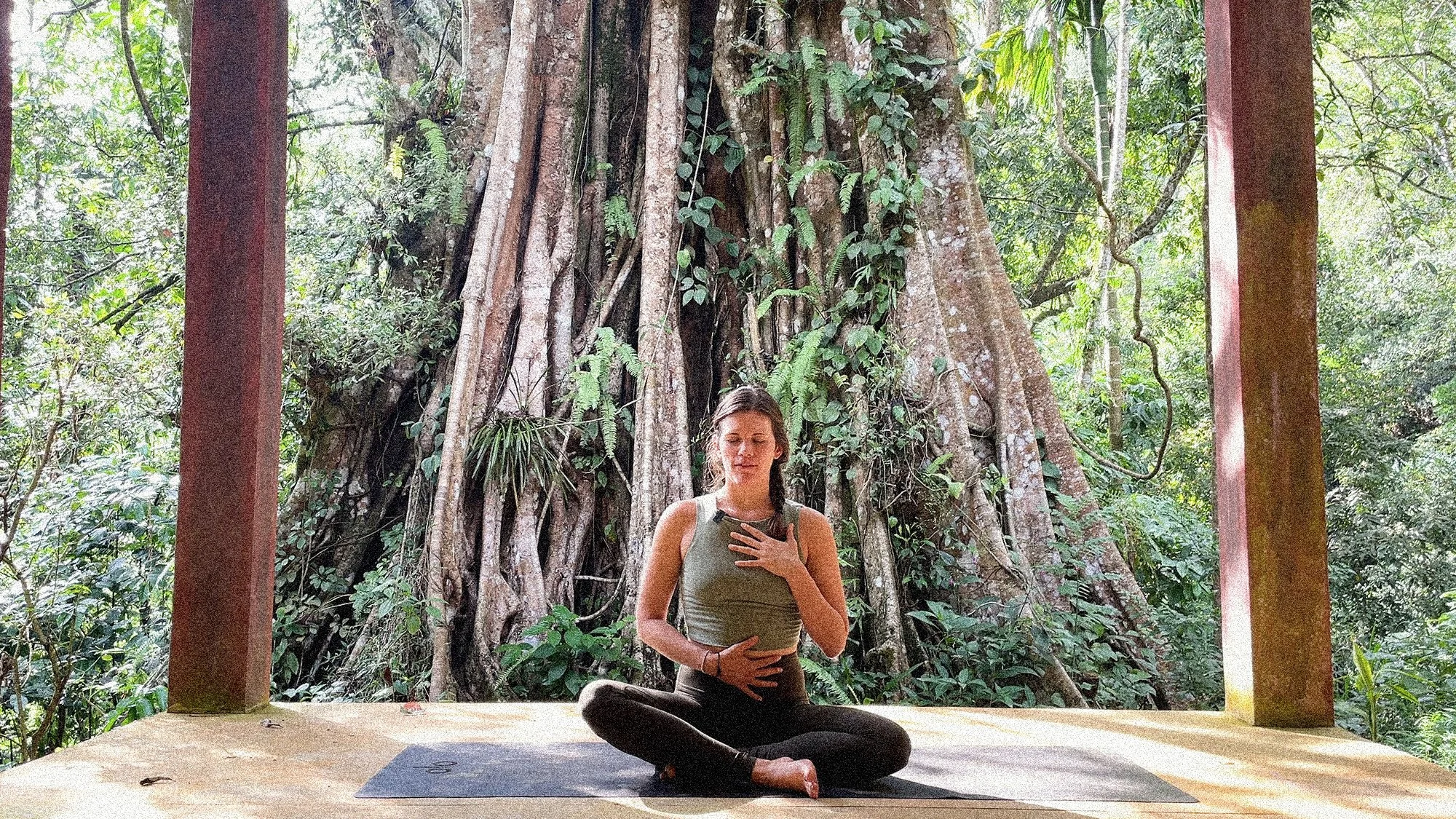
A few steps into your self-led New Year’s Somatic Inquiry
A full Somatic Inquiry is usually done together with a trained somatic coach who is there to reflect back to you, co-regulate, and help you hold the focus on sensations and details that will then lead you further down the rabbit holes of your inner truth. It is one of main tools in Somatic Coaching and usually repeated over some time, weeks or months, in order to become more familiar with your inner landscape, and deconstruct bigger blocks and unfold wholistic visions.
But even if you’d ike to give it a go for yourself, and find out how you truly feel about your New Year’s resolutions right now, you can follow these simple steps, a self-led, simplified version of what I do with my coaching clients when we enter a Somatic Inquiry session:
1. Make space for your inquiry
Before you begin, take a moment to create an environment for yourself that supports your self-inquiry. Find a quiet place where you won’t be interrupted and carve out at least 15minutes of your time.
Turn off your phone, have a journal ready, and make sure you are really, truly comfortable.
When we are working with the body the whole process of introspection can only be initiated when are honouring its needs for regulation. Comfort can mean different things to different people, so go with what works for you. Get an extra cushion, sit in your favourite chair, light your favourite incense…
The littlest symbolic act of self-care is setting the stage for your inner work - and probably just feels really nice ;)
2. Slow down and orient
Other than with classic New Year’s resolutions, we reverse the order of things a little bit. Instead of starting out to get to goals fast, we first take some time to slow down.
Like, really.
Chances are high that the place you come from in your day when you enter your inquiry has a higher pace and intensity than what we need in order to hear our somatic responses.
Before you go inwards, allow your nervous system to down-regulate. My favourite most simple practice to start with is called “orientation”, which eases our most used visual sense.
Sit comfortably, keep your eyes open, and gently look around the space you are in. Let your eyes wander around, and focus on what you are seeing without analysing it.
What colours, shapes, materials can you make out?
Practice seeing simply for the sake of seeing. If your mind begins to wander on, just let your eyes move on.
This practice naturally calms the mind and prepares the body for deeper self-reflection.
3. Lead yourself in
Once you feel more grounded, slowly start drawing your attention inwards. If it feels right, close your eyes.
You can draw a gentle body scan, beginning at your toes and moving your awareness gradually upward through your body, noticing and relaxing any tensions along the way.
Gradually, allow your attention to sink in deeper, connecting with the emotional layer within your body. It’s the place where you can sense your mood, and your overall feeling.
Take your time to settle here, and again, get comfortable.
4. Pose your inquiry.
When it feels right, gently drop your question into your inner space. Remember - this is not a New Year’s resolution.
Not a goal.
It’s a self-inquiry, a question that leaves many open edges to its possible unfolding. It is much subtler, posed with an open mind and an attitude of curiosity.
It could be something that’s been sitting on your heart for a while, or simply the first thing that comes to mind.
There’s no need to overthink or analyse, trust your intuition and let your body take it from there.
5. Listen.
Now we are coming to the core of the exploration.
Once your question, your inquiry is out there, down there in your body, take a moment to pause and listen.
It is a different kind of listening, not one that is looking for words, but one that is sensing into bodily sensations, feelings, or sudden thoughts. Somatic responses may not always come in a clear language but could manifest as subtle expressions, emotions or hunches.
You might not feel anything, and that’s fine. Over time, you’ll get more fine-tuned in hearing your own inner responses.
If you work with me in my Somatic coaching programs, I’ll help you focus and follow your inner nudges so we can go deeper.
Things to look out for while you are listening could be:
* What sensations am I noticing in my body right now, and where are they located?
* If this sensation could speak, what might it want to express or share with me?
* How does this part of my body feel when I focus on it with acceptance and curiosity, rather than judgment?
* Are there any emotions or memories connected to what I’m feeling in my body?
* What might this sensation need in this moment to feel safe, supported, or heard?
* How does my breath shift as I bring awareness to this part of myself?
* If I could release tension from this area, what might fill the space in its place?
* What would it feel like to approach this experience with compassion instead of resistance?
6. Journal
After your inquiry, take a few moments to note down any observations or insights.
Don’t worry about whether the words come out perfectly - they don’t need to make sense (yet). The act of writing helps to externalize your inner experience, and creates a record of your exploration that you can revisit or reflect upon later.
7. Rest and integrate.
Finally, allow yourself to rest. Give your body and mind some space to integrate what surfaced during your inquiry.
Even if you came out with no clear insights, trust that your inner process has begun, and may continue unfolding over the coming days or weeks.
There’s no rush or agenda, knowing that our body’s life-forwarding character will bring up the next steps and dots to connect.
Go on living your life, and return to the practice when you feel called to.
Please note: These steps refer to an abbreviated version of the kind of Somatic Inquiry I am guiding my clients in. It’s a great tool to ground and start building a relationship and connection with your inner Self.
However, if you are looking for deep, transformational growth, doing it by yourself is a bit like scratching the surface of the water and stepping one foot in.
To facilitate deeper work and find out more about your inner dynamics and, oftentimes, twisted and blocked life paths, you need to engage with a somatic coach that you trust, and who can steward you compassionately and steadily on the path of self-discovery.
I am here for that. Let’s talk more.
Adjusting the compass towards True North
Life has its way of pulling us in many directions, sometimes faster than we can catch our breath, especially at the beginning of a New Year.
The pressures, decisions, and uncertainties we face oftentimes seem to leave little room for stillness, for truly listening what’s stirring inside us.
But you do have space. You do have time.
You do know this quieter voice - the deeper knowing that resides within yourself, your body, waiting to be heard. It holds your clarity, resilience, and truth, and is accessible to you even when life feels overwhelming.
Rest assured that you are not alone in all of this, you don’t need to carry all the weight and tap around in the dark. What you really need is already there, stored in your somatic memory as an inner compass.
Somatic Inquiry is an invitation - not a quick fix or force - to connect to this intuitive wisdom and explore, hold space, and extract what’s truly alive for you right now.
If you are ready to gently reconnect, find clarity, and access direction towards your True North in this season of life, I am here to walk beside you, and help you align with the purpose and ease you seek.
With Love,
Elena