

What is Somatic Coaching?
Insights into the art of body-oriented healing

Living authentically is becoming more and more important for many people.
Collectively, our society is going through a phase of intense change, chaotic environments, and overwhelming stimulation. Even in a life that, at first glance, looks ordinary and settled, is following the norm, and doesn’t call for major drama, the human inside might very well be depressed, confused, or in general just out of touch with themselves.
Luckily the tools available for self-help are vast and various. From Yoga over meditation techniques to Inner Child work and therapies, we have well-researched and well-known modalities on our hands to improve our personal well-being.
Somatic Coaching is a relatively new term for techniques and practices that have been around for a long time.
Derived from the Greek word “soma”, which literally means the “body, organism in its wholeness” this new coaching approach puts a heavy emphasis on the body’s part in the process of healing and expands the understanding of the mind-body-connection as a two-way street.
Body heals mind, mind heals body.
In this article, I will draw from my own experience as a certified Somatic Coach and cover the main questions you might have in-depth:
What is Somatic Coaching, who is it for, what can it help you with, what makes it stand out from psychotherapy and other approaches, what are the techniques used, and, as a little bonus from me as a passionate Somatic Yoga teacher: how does this coaching modality go together with mindful movements?
Enjoy the read and comment for questions and reflections!
If you’d like to dive straight in and be introduced to somatic work, and how it can help you deepen your embodied confidence through Nervous system regulation, somatic inquiry and Yoga, you can go straight ahead and book a free Introduction call with me (no strings attached!).
Table of Contents
What is Somatic Coaching and what makes it special?
1.1 Supporting the efforts of the mind with the wisdom of the body
2.1 Quick Fixing
2.2 Therapy
2.3 Advice Giving
What are the Tools of a Somatic Coach?
5.2 Somatic Inquiry
What is Somatic Coaching and what makes it special?
The International Coaching Federation (ICF) defines the work of coaching as the following:
“Partnering with clients in a thought-provoking and creative process that inspires them to maximize their personal and professional potential”.
This definition holds a wide range of niches for coaches to work with, like career coaching, life coaching, and relationship coaching. All of them work with the mental intelligence of the person to stir them into a desired direction and achieve some sort of goal.
The body-oriented way agrees with most of those general definitions. However, it adds three interesting components to a more expanded understanding:
1. Supporting the efforts of the mind with the wisdom of the body
As the name already suggests, somatic, or in other words, body-oriented coaching takes the body into account when it comes to personal progress. It acknowledges the mind and body connection and digs into the deep well of our internal intelligence that goes beyond the mind and its intellect.
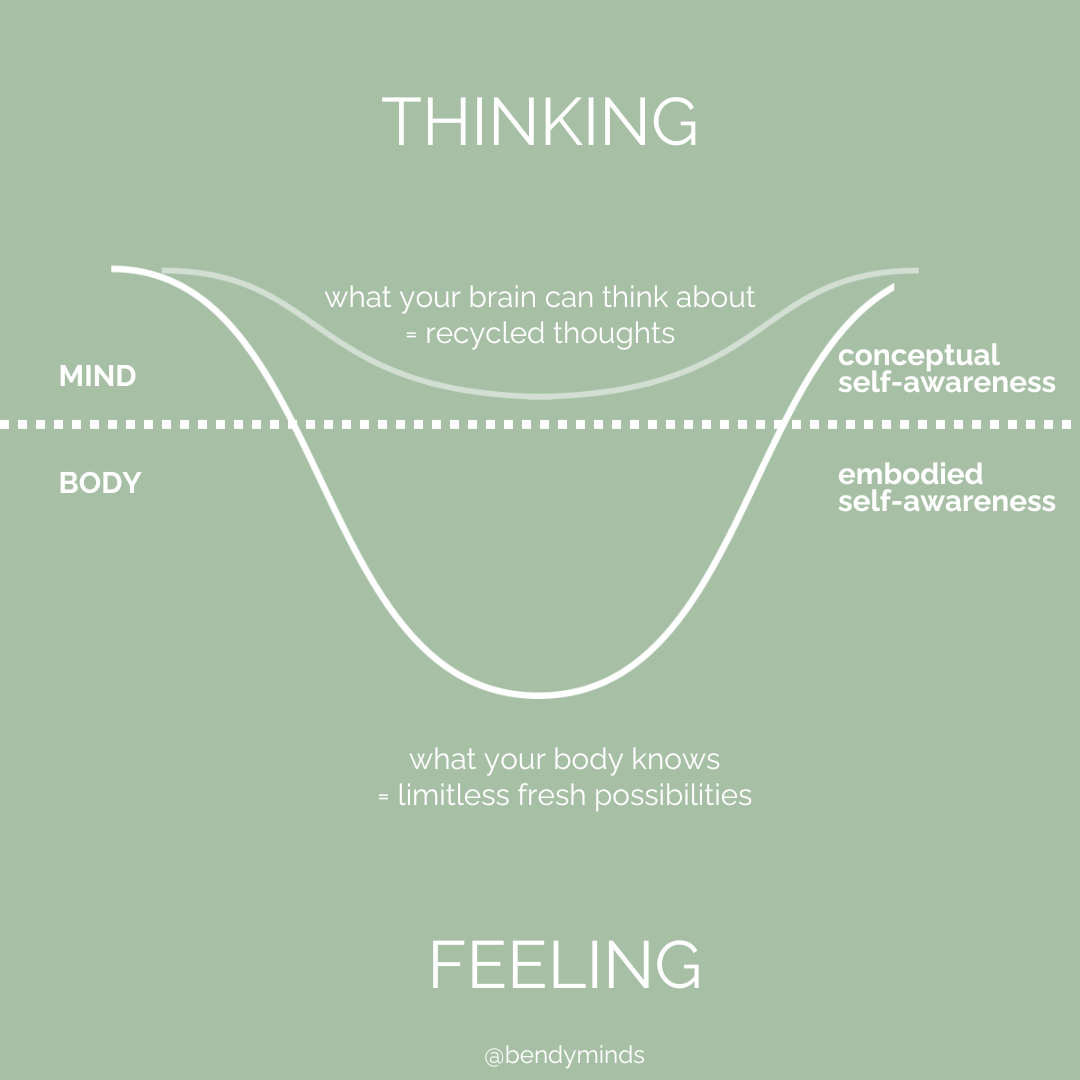
The brain is a fantastic tool that has the ability to make sense quickly and categorize experiences according to what it has already lived through. In fact, it is this capacity to create neural pathways of repeated behaviour that keeps us from starving or running into unexpected danger.
Our brain’s priority is our survival, and it will always prioritize safety over newness.
However, the over-emphasis on cognitive (= mind-oriented) sense-making might be part of the problem of why people oftentimes stay stuck in their life situations despite classic coaching or even therapy.
What is different in Somatic Coaching is that instead of just relying on the repeated thought patterns of the mind, it invites the wider, more tangible feeling sphere of the body.
Insights from a Somatic Coaching session are drawn from the collaboration of the intellectual headquarters of the brain and the intuitive, sense-oriented, imaginative, in short, the embodied depth of our soma (the collection of our body, physical sensations, intuition).
It is believed that our body reads, interprets, and stores endless little pieces of information in our Nervous System while we are going through our life experiences. Similar to our mind, the body has the same function to keep us alive and keep us safe, but is equipped with a wider capacity for the different possibilities and has a slower and more generous relationship with the element of time.
The body’s intent is to not only have us survive but have us be well.
In the body-oriented approach, intellect and feeling do not at all exclude each other but work together as a multidimensional, non-dogmatic, two-way street. Together, they form what we call the bodymind.
In a combination of bottom-up and top-down methods, we bring a heightened attention to physical sensations, movement impulses, and postures and link them with sudden sparks of inspiration, ideas, epiphanies.
Instead of just following the old question-answer model, we weave a non-linear, wider net, a process of self-inquiry that includes various forms of “knowing”.
2. Vulnerability as the pathway to healing
The second aspect that makes this healing modality so special is its relationship with vulnerability and fixing.
With our society becoming more and more fast-paced and competitive, most of us unknowingly sooner or later drift into a mode of needing things to get solved fast and needing to know exactly what is wrong so that we can fix it. Both of these attitudes stem from a deeper insecurity of having to function no matter what and leave us with little to no opportunity to catch our breath or feel into ourselves.
Because what is under the surface of the “known”, the “defined”, and the “what’s working” can be scary. It is the underworld of emotions, feelings, fears, and pain.
And it is also the world of a different kind of knowing, home to our highest dreams and deepest truth. It is the place where our true self lives, waiting for us to make contact with it.
What Somatic Coaching does is make space for all those parts of ourselves that usually have to hide away in our day-to-day lives.
Instead of pressuring towards results and nailing down goals, a Somatic Coach will guide you to slow down, lean back, and watch the process. We are not trying to immediately fix anything, and we are allowing things to be as they are.
This includes the kind of emotions that we are usually not so fond of encountering. All the heavier sentiments that weigh on your chest, a fear that lingers on your shoulder, or a grief that sits somewhere deep inside your stomach.
We trust that your organism itself has all the information it needs to move forward in the way that is most useful. We call it a natural life-forwarding tendency.
Instead of pushing what hurts us away, we learn to sit with it and hear it out. The rest will take care of itself.
Soft is the new strong.
3. The magic of the in-betweens
If I am asked what Somatic Coaching is, my answer is oftentimes: “two humans having a conversation with the focus on one of them”.
The keyword here is co-regulation.
Us humans are not made to be isolated. We can see the results now of what it means to be locked away in solitude over an extended period of time, of not being in touch with other beings.
Our Nervous Systems are built as powerful circuits with open-ended sensors on all sides. We are biologically wired to react, interact, and sense into other human beings without even having to think about it. It is our ventral vagal nerve, the latest of the branches of the Vagus Nerve running through our body, that helps us connect with others on a social level.
When we start our Coaching conversation, no matter if it is taking place online or in person, we enter a shared space of trust, presence, and co-regulation.
This safe field is especially important when we work with topics that are highly emotionally charged, painful, or even traumatic. The presence of a well-regulated, attentive, and safely attached human can be the key to being able to access this emotional depth without your Nervous System going on overdrive.
Basically, I hold the space while you hold yourself.
Within this safely held space, we then have the opportunity to explore beyond what your mind already has thought of, resist the urge to prematurely lock in fixed solutions, and instead discover new, oftentimes surprising possibilities of “being” within yourself, that carry in them the next steps for you to move to a more aligned version of yourself.
Everything is welcome, and nothing is expected.

What Somatic Coaching is not
As elaborated in the section above, Somatic Coaching is a concept of mind-body connection, emotional inclusion, and co-regulation.
Since the methodology is still young in its emergence, and the philosophy still something like a paradigm shift, we need to be clear at this point what Somatic Coaching is not:
1. Quick Fixing
When we want to evolve authentically, we need to be thorough. It will not be enough to think our way through and expect a quick change or fix to happen for us and solve all our problems.
Any advertisements of miracle fixes in short amounts of time should be looked at with a hint of suspicion, in my opinion.
Most of us endure years of living under false conditions, and our minds might have a whole package of blocks and stuck beliefs stored in the crevices of our subconscious.
The likelihood of getting all of this removed within one day or one week is pretty low.
Real transformation needs more than just a change of mindset.
What we are working on during somatic coaching programs is consequently hearing out unfelt and buried emotions and relaxing into them, a process that might have to be repeated a couple of times until we hit the right spot.
What happens through this kind of patience is what’s called a somatic shift.
More than just a change of thought, this kind of shift is a transformation towards a different way of being, a different kind of living in your body, without the tension of the stored blocks that you carried before.
In my experience, we need to give it at least around two months of coaching, regulating, and soothing to allow this shift to happen. This is why my coaching program is designed as a multiple-month container and involves Somatic Yoga and breathwork to support you during the process and keep you motivated.
2. Therapy
Even though the Somatic Coaching approach draws from different techniques of mindful psychotherapy, it is still very different.
The main difference is that psychotherapy mostly focuses on the past, while Somatic Coaching works with the present.
We don’t have to necessarily understand what brought us to the situation we struggle with in order to change the way are moving on. Depending on the case, it could even be detrimental to again and again cycle around the story of the past, working with oftentimes diluted material, clouded by memory, and sometimes even flavoured by false interpretations of our mind.
When we work with the body, we work in the present.
We are making use of the fresh insights we can draw from a feeling, a sensation that is born in this moment and has access to the truth that is within us.
3. Advice Giving
This is one that cannot be stressed enough.
A good Somatic Coach will never tell you the solution to your problem. As much as it can feel good to be told what to do exactly and to receive inspiration from another person, this belongs in the fields of friends and family, but not in body-oriented coaching.
In this scenario, you are the leader, and your soma is your problem solver.
Don’t get me wrong, you are by no means left alone in this, as we will still establish your safe space together, and your coach will be there for you empathetically and collaboratively.
But when it comes to defining the pathway and drawing conclusions, you are the one calling the shots.
How else should it be, given the immense wisdom your bodymind is carrying, that is completely unique to you, and to you only, during your experience of your life, in your body, with your mind?
Who else could make real sense of all this other than you?
Experience shows that this point can be a hard one to swallow at first. Even as adults, as fully grown individuals, we still have a habit of craving validation and reassurance from outside, and oftentimes are used to trust external advice more than our own intuitive knowing.
It’s a phenomenon I see all the time, and it calls for a reassessment of self-responsibility and self-literacy.
Luckily you have your Nervous System on your side. And the more you create that inner safety, and the better you learn how to read your own internal language, the more you can start to trust yourself and the bigger the steps you can make with it.

Is Somatic work right for you?
As you can see, working with the body requires a certain level of maturity and readiness to face aspects of yourself that might not be as shiny as you would usually admit.
Somatic Coaching is a process of self-inquiry and might very well get you in touch with uncomfortable feelings or hard-to-swallow truths.
It is a powerful practice for the growth-oriented and the sensitive, who are willing to look beyond what they already know. It’s for the ones who are thirsty for truth and tired to be anything that they are not, or living a life that doesn’t feel right.
It will work well for you if you come with an open mind and an experimental attitude. You will have to put in the work, let the shifts happen, and support yourself through your resources.
It is a process that takes some guts but might get you right to where you want to be in life, or rather, who you want to be. It leads straight to yourself.
Somatic Coaching is an assisted self-study that is best done with a certified Somatic Coach, who can ease you into the process, help you navigate the unknowns, and recognize when you touch on trauma.
If you would like my help, just go ahead and schedule a free Intro call. We will look into your situation, your struggles, your pain points, and figure out if my method might help you to shift and heal.

What happens inside of a Somatic Coaching session?
While big characteristics of this style are non-linearity and experimentation, there are certain elements you will find in most of the sessions, depending on the specialty and character of the coach and the dynamic between the coach and the client.
It is, of course, impossible to define the exact pace, flow, and order, but here is, for example, how a session might look like with me as your coach:
1. Orientation and Grounding
At the beginning of our conversation, we set the stage for our exploration. The advantage of working online is you are at home, in your comfort zone, in a trusted surrounding.
We’ll use this setting as a starting point and spend a few minutes to let your body arrive, settle, connect with your breathing, stretch, and orient yourself.
It’s a principle that is drawn from Organic Intelligence, a scientific study field that teaches us how to connect with the simple, ever-present resources in our organism that are here to counterbalance dysregulation in our Nervous System (like anxiety, nervousness, and tension) by signaling to our brain that we are in fact safe and relaxed.
2. Letting the Topic emerge
When you feel grounded and centered, we are opening the stage for your topic.
It will look a bit like a normal conversation but with the focus on you. We will let you talk freely, without restrictions, while I ask clarifying questions to create some context.
It is completely up to you how much or how little you give away about your story. What we Somatic Coaches focus on is the wholeness of you while you are telling it.
String by string, we will work our way down to the essence of what is most important to you today.
3. Embodied Self-awareness
After defining the starting point of our inquiry, the North Star of the session, we’ll start diving into your embodied self-awareness.
With an open, non-pressured, non-judgemental attitude, your coach might lead you through gentle interventions that invite physical sensations to come to word, create third spaces of intuitive knowing, or follow movement impulses.
This is the space where you learn how to feel yourself, to listen, to linger, and to watch.
It is the core part of our time together, the deep dive into the unconscious material. Here is where deep understanding, aha-moments, somatic shifts, and emotional healing can take place.
4. Neural Integration
Towards the last part of the session, we will start to collect the treasures we found in the depth of the somatic dive and gently bring them up to the surface.
Here is where we invite the cognitive mind to join our conversation again and see what kind of conclusions it can draw from the new insights of the body.
It is oftentimes the moment where we linger a little longer to take in the new feelings and to give your brain the chance to soak in and bath in the revelation.
It is the starting point of initiating the long-term transformation in your mind and in your body.
5. Neuroplasticity and Muscle Memory
At the end of our call, we’ll define a takeaway and design a personalized practice for the time in between sessions.
While the insights we draw from a Somatic exploration can be groundbreaking, we need to integrate your somatic shift, your new way of thinking and being, into your daily life, so it can manifest itself permanently as a new habit.
This is a practice that doesn’t happen overnight, which is why my programs start from a minimum of 3 three months, so that we can start seeing some shifts happen.
Supporting practices can be body-based, like Somatic Yoga, and they can be mind-centered, and they work best if mixed and approaching your organism from the top down and the bottom up.
The factors that determine the effectiveness of this integration are consistency and relevance, two things a multi-faceted coach will be able to help you with by tailoring your integration routine.

What are the Tools of a Somatic Coach?
Now that you know the rough framework of what a typical session looks like, let’s dive a little deeper into the tools a body-oriented coach uses.
You might notice that most of them seem to be very simple, and accessible for any person.
That’s exactly what this is all about! Reconnecting to our natural support system that is already inherent in us, and learning how to use it.
Here we go:
1. Nervous System Regulation
The mind-body connection stands at the center of body-oriented coaching.
Change is scary.
It might be obvious, or it might be subtle, but every move that you are attempting to make out of your comfort zone, or even just out of your “known” will, in some way or the other, activate your Nervous System.
Scientists have found out that our autonomic nervous system has developed several strategies to respond to external stimuli, in particular, danger. It is known as the Polyvagal theory.
If we are going beyond our capacity, like making big leaps of faith when we are not ready or moving too fast with our change process, our nervous system can easily go into fight/flight, or, alternatively, freeze mode. It is a reaction that is mostly happening beneath our awareness, through our inherent capacity of neuroception.
What’s interesting for us as Somatic Coaches is the third stage of nervous system response, which is social engagement.
This is the state where we can step back, see the bigger picture, and see difficulties as challenges rather than obstacles.
In our sessions together, we use the simple hack of co-regulation between coach and client in order to create a conducive environment for your nervous system to handle the intensity of the change process and find appropriate, safe, step-by-step responses.
The Nervous System regulation tools I use come from Somatic Yoga, breathwork, and the framework of organic intelligence.
2.Somatic Inquiry
A big part of an effective coaching session is conversation.
This is where we bring the topic to the table, unpack, and invite our cognitive mind to give us as much data as we need in order to understand the situation, the desired outcomes, and the obstacles.
Other than in conventional coaching conversations, a Somatic Coach will not just listen to the words that are said but also to the cues the body gives away while you talk.
Changes in posture, tone of voice, frowns, unconscious hand gestures, sighs, eye movements, are all communications from the bodymind that gives us hints to where deeper motivations are buried or where the truth might be hidden by conditioning and patterns of thought.
Those cues are subtle, but they point to the bottom of the iceberg.
A certified somatic coach will have trained the skills to listen on a holistic level and to guide the client to follow the little nuggets of body wisdom to unlock the way to the inner transformation that needs to happen in order to achieve the change that is desired.
A simple conversation becomes a somatic inquiry.
3. Experiments with the Bodymind
In the core exploration phase of the session, a coach might make use of little experimental interventions that nudge the bodymind to tell us more about the situation.
After the client’s topic has been opened and “warmed up” by the cognitive part of our intelligence, these embodied experiences might forward the stream of discovery and lead us to the core of the matter.
Examples of those interventions could be techniques like Focusing, Hakomi, Constellations, Visualizations, or Embodying.
4. Slowing down, Silence, and Loving Acceptance
The last set of tools that make this style so special are also the ones that oftentimes fall under the radar of our day-to-day lives.
Slowing down - how often do you usually take a moment to just feel into yourself or let an experience sink in before you move on to the next task?
Silence - resisting the urge to fill the gap with words, to say something just for the sake of saying it, and instead sit with your inquiry while you are letting yourself marinate in it.
Loving acceptance - a principle so unique that it deserves its own post. In a society where functionality stands at the top of the hierarchy, and emotions are seen as a tolerated nuisance yet pushed away quickly the moment they get “difficult”, how would it be to feel fully accepted and fully accepting everything and anything that comes up, no matter how ugly, or harsh or hurt a part feels?
All those three combined give us the gift of space, grace, and self-compassion, qualities that will have your back and carry you through while you make your transition.
What are the Benefits?
As individual as each and every transformation journey is, so are the potential outcomes.
The results can be obvious or they can be subtle, depending on what you specifically need them to be, and they can vary according to the time frame you are working with (for example, you won’t see big changes after just one session, but will be able to allow substantial shifts over a few months ).
Most importantly, whether you will be successful with this method or not depends on your own motivation to stay consistent with your self-work and your willingness to allow whatever needs to emerge to help you through the process.
Here is a condensed overview of the benefits that the majority of my coaching clients experience after my 3 months program:
Heightened self-awareness
Stress-resilience
Higher priority to take good care of themselves
Self-compassion
Body-literacy
Bigger capacity to face challenging emotions
Trust in themselves
Confidence in showing up more authentically
Clarity about decisions
Readiness to take the next step or a bigger leap
Topics you could bring to the Program
I am structuring my programs in a way that leaves maximum flexibility to what you’d like to bring as a topic.
Following the principle of the life-forwarding tendency of your organism and working with the present moment, we trust that whatever is important will emerge by itself at the exact right time to tell you exactly what you need to know in order to move forward.
Deep down, you already know what is important right now. We just have to listen.
This means you do not have to know what exactly your transformation journey will look like when you are starting out. What would be the fun of that, anyway?
All we need to get you on track is a starting point.
This could be a situation that you find yourself in recently, a pain point you are experiencing, or an uncertainty about life choices. It might simply be equivalent with why you considered hiring a Somatic coach in the first place ;)
Here are a few topics that clients have brought to me:
Feeling overwhelmed by their job or wanting a career change
Challenging relationship dynamics (partnerships, family, friendships)
Difficulties of setting boundaries
Wanting to feel more connected with themselves
Feeling lost in the hecticness of life
Going through phases of transition or grief
Needing to build more confidence and step up for themselves
Dreaming of a bigger life that is more authentic to them
Being unable to take proper care of themselves
Feel free to use this list as an inspiration, and remember, the program will be 100% customized for you.
You can bring whatever is alive in you right now, and it will lead you on the right track.

How to get Started
If you are feeling a sense of curiosity in upleveling your life and allow yourself to be more authentic, but still feel a bit unsure whether the body-oriented work is the right thing for you, I got you.
Initiating change in your life can be an activating endeavor, and the investment and time commitment might seem scary. This is a totally normal, and a well-meant response of your Nervous System to keep you safe (aka unchanged!)
I take all my interested clients through a preliminary free Introduction call, where we can simply get to know each other, have a chat about what’s bugging you, and see if we can come up with a strategy for how my work can help you.
There is no rush and no pressure. You are calling the shots, and only you can know when is the right time for you to make a change.
Let me know when you are ready, and select a time that works for you.